Five Milestones in AI That Shaped AdTech
AI may feel like the hottest new commodity, but in digital advertising it has been quietly shaping the industry for two decades. From predicting clicks in the early days of the internet to today’s conversations around agentic AI, each leap has transformed how campaigns are planned, delivered and optimized. Here are five milestones that tell the story of AI’s journey in adtech — and what might come next.
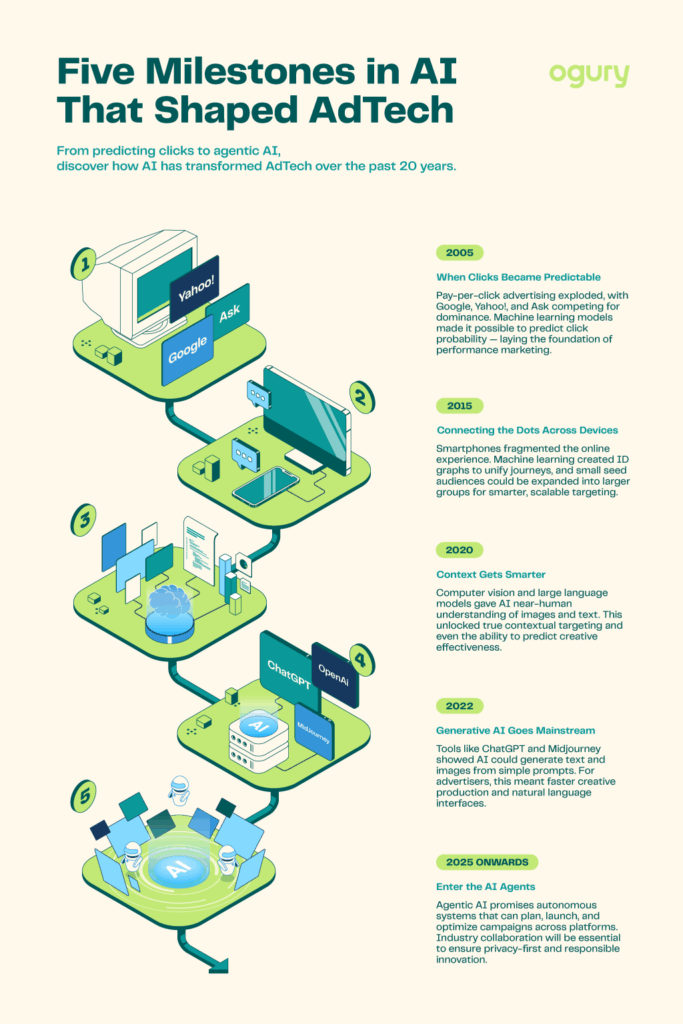
2005: When clicks became predictable
The rise of pay-per-click advertising turned search into a multi-billion-dollar market, with Google, Yahoo!, and Ask battling for dominance. Success hinged on one thing: predicting who was most likely to click.
Machine learning models unlocked this ability by analyzing massive volumes of search data to identify the patterns that made a click or conversion more likely. This was the foundation of performance marketing as we know it — and the first time AI truly powered digital advertising at scale.
2015: Connecting the Dots Across Devices
As smartphones and apps reshaped the online experience, advertisers faced a new challenge: fragmented user journeys across multiple devices and platforms. Machine learning addressed this by stitching together ID graphs, creating more consistent consumer profiles, and enabling smarter targeting.
The same technology also powered audience extension, where small seed groups could be probabilistically modeled into much larger audiences. With GDPR taking effect in 2018, this became even more valuable — allowing marketers to expand reach with consented data while staying within privacy boundaries.
2020: Machines Get Smarter
Advances in computer vision gave AI near-human abilities to understand visual media (trained, in part, through CAPTCHA forms), while large-language models (LLMs) brought the same power to text. Together, they unlocked a new level of speed, scale, and accuracy.
This was a significant breakthrough for contextual advertising, long hampered by crude keyword tagging and limited reach. For the first time, AI could match ads to content through real contextual understanding — and even predict which creative elements would perform best before launch.
2022: Generative AI Goes Mainstream
Generative AI flipped the script. Tools like Midjourney and, most famously, ChatGPT pushed AI out of the back-end and into the headlines. Instead of simply interpreting media, they showed how AI could generate text or images at speed and scale using simple prompts.
For advertisers, the appeal was immediate: faster creative production and interfaces that could be operated through natural language. But with the hype came confusion, as not every so-called “AI-powered” transformation represented genuine innovation.
2025 and Beyond: Enter the AI Agents
Today, the industry is buzzing about agentic AI — autonomous systems that can conceptualize solutions and test multiple approaches to optimize campaign performance in real time. Imagine a single system that can set up campaigns across platforms, adjust creatives, and reallocate spend automatically to hit strategic goals.
The potential is enormous, but success will hinge on collaboration and interoperability. Agentic AI will inevitably disrupt the balance of power in adtech, reshaping relationships between vendors, agencies, publishers and platforms. Only by working together can the industry unlock AI’s true value and ensure it powers responsible, privacy-first innovation.
At Ogury, we are building for that future. By combining AI with our Personified Advertising technology, we give brands and agencies the ability to plan, activate, and optimize campaigns responsibly — delivering performance at scale while protecting user privacy.
Want to learn how Ogury can help you take AI to the next level? Get in touch with our team at hello@ogury.co.
Subscribe to
The Ogury Outlook
Get expert insights, industry news, events and actionable tips.